


If you’re selling products online, whether on Amazon, eBay, Shopify, Walmart, or your own website, every sale you make triggers a chain of actions: stock needs updating, a label needs printing, a parcel needs tracking, and a customer needs notifying. Do this manually across multiple channels, and you’ll quickly find yourself overwhelmed.
This is exactly what an Order Management System is designed to solve. In this complete guide, we’ll explain what an Order Management System is, how it works, what features to look for, and why every serious eCommerce seller needs one.
What Is an Order Management System?
An Order Management System is software that centralises and automates the entire lifecycle of a customer order from the moment it is placed through to fulfilment, shipping, and post-sale management.
For eCommerce sellers, an Order Management System typically handles:
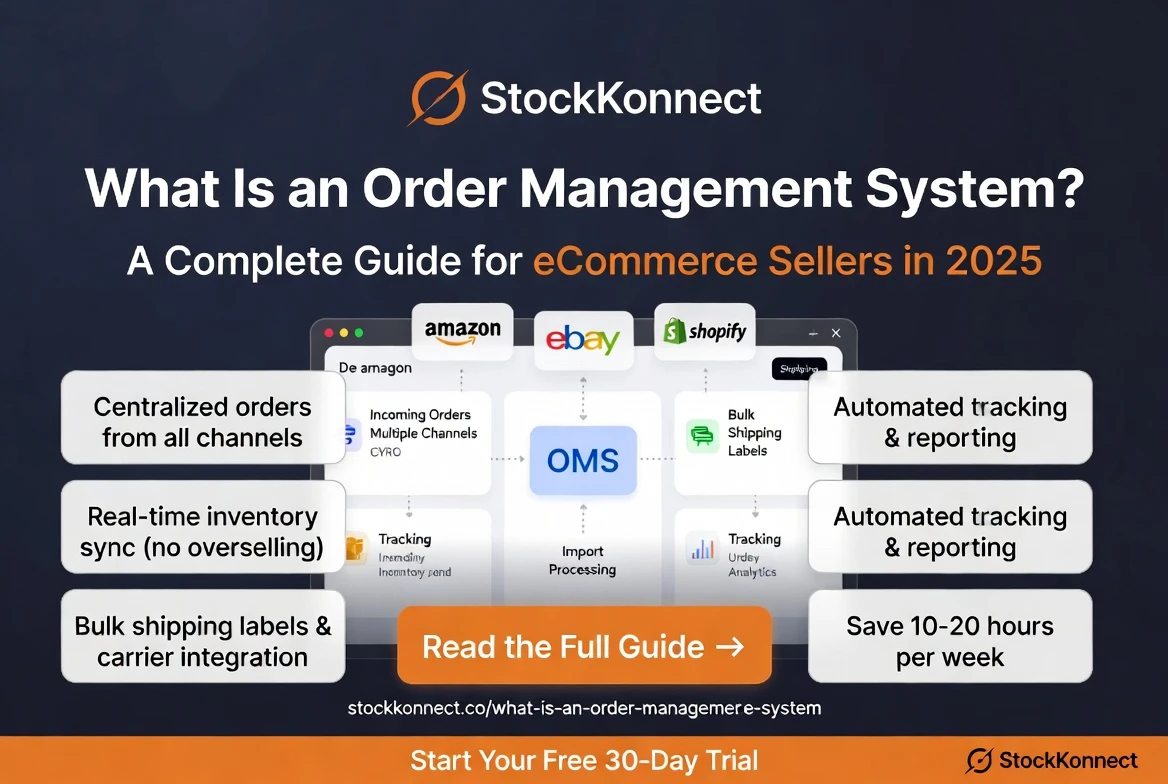
- Order capture: Automatically pulling orders from all your sales channels into one central dashboard
- Order processing: Managing order statuses pending, processing, dispatched, delivered
- Inventory updates: Automatically deducting stock when orders are placed and syncing levels across all channels
- Shipping management: Generating labels, communicating with carriers, and tracking parcels
- Reporting: Providing data on order volumes, fulfilment times, and revenue by channel
How Does an Order Management System Work?
A modern and centralized order management System integrates directly with your sales channels via APIs. Here’s what happens when a customer places an order:
- Order placed: A customer buys a product on Amazon, eBay, or your Shopify store.
- Automatic import: The Order Management System instantly pulls the order into the central dashboard no manual checking required.
- Stock deducted: Inventory levels are automatically updated across all connected channels in real time.
- Label generated: A shipping label is created automatically based on the order details and your carrier settings.
- Order dispatched: The parcel is shipped and tracking information is automatically sent back to the marketplace and customer.
- Order complete: The order status updates automatically and the data feeds into your performance reports.
All of this happens automatically, without you lifting a finger after the initial setup. This is the power of a well-configured Order Management System.
Why Does Every eCommerce Seller Need an Order Management System?
Whether you’re processing 10 orders a day or 1,000, an Order Management System provides critical benefits that manual processes simply cannot match:
1. Eliminate Costly Errors
Manual order management is error-prone. Wrong addresses, incorrect quantities, missed orders these mistakes damage your seller reputation and cost money to fix. An Order Management System eliminates the human error factor by automating every step of the process.
2. Scale Without Hiring More Staff
As order volumes grow, manual management requires more people. An Order Management System lets you handle 10x the order volume with the same team or even fewer people because the system does the heavy lifting automatically.
3. Prevent Overselling Across Channels
If you sell on multiple platforms without an Order Management System, you risk selling the same item twice once on Amazon and once on eBay before your stock levels update. An Order Management System syncs inventory in real time the moment any sale occurs, making overselling virtually impossible.
4. Protect Your Seller Metrics
Amazon’s Order Defect Rate and eBay’s seller performance metrics are both severely impacted by late shipments, cancellations, and fulfilment errors. An Order Management System keeps your operations running smoothly so your metrics stay strong and your listings stay visible.
5. Save Significant Time Every Week
The average multichannel seller spends 10-20 hours per week on order-related tasks without an Order Management System. With automation in place, that time drops dramatically freeing you to focus on growth rather than admin.
6. Get Full Visibility Across All Channels
Without an Order Management System, understanding your overall business performance means logging into multiple platforms separately and trying to piece together a picture. An Order Management System gives you one unified view of every order, from every channel, in real time.
Without an Order Management System vs With Stock Konnect: A Direct Comparison
Here’s a clear breakdown of how your day-to-day operations change once you implement an Order Management System:
| Without an Order Management System | With a Basic Order Management System | With Stock Konnect |
|---|---|---|
| Manual order entry | Automated order import | Real-time multichannel order sync |
| Separate logins per channel | Single dashboard | Unified dashboard all channels |
| Manual stock updates | Basic inventory tracking | Real-time automatic inventory sync |
| Individual label printing | Batch label printing | Bulk labels + carrier integrations |
| No reporting | Basic sales reports | Full performance analytics |
| High overselling risk | Reduced risk | Overselling eliminated |
| Hours of manual work daily | Some automation | Fully automated workflow |
Key Features to Look for in an eCommerce Order Management System
Not all Order Management Systems are built the same. When evaluating Order Management System software for your eCommerce business, prioritise these essential features:
Multichannel Order Consolidation
Your Order Management System should pull orders from every channel you sell on Amazon, eBay, Shopify, WooCommerce, Walmart, Etsy into a single, unified dashboard. If you still need to log into individual platforms to check orders, your Order Management System isn’t doing its job.
Real-Time Inventory Synchronisation
The Order Management System must update stock levels across all channels the instant an order is placed not every 15 or 30 minutes. Even a short delay creates a window for overselling that can lead to cancellations and account penalties.
Bulk Order Processing
The ability to process, pick, pack, and dispatch multiple orders in one action rather than one at a time is essential for growing sellers. Look for bulk status updates, bulk label printing, and batch picking workflows.
Shipping Carrier Integrations
Your Order Management System should connect directly with your preferred shipping carriers Royal Mail, DHL Express, Low Cost Parcels and others for automatic label generation, rate calculation, and shipment tracking. Manual carrier management kills efficiency.
Order Status Tracking
From pending to dispatched to delivered, your Order Management System should provide a clear, real-time view of every order’s status with automatic updates pushed back to the relevant marketplace so customers are always informed.
Reporting and Analytics
Comprehensive reporting helps you understand which channels generate the most revenue, which products sell fastest, and where operational bottlenecks exist. Data driven decisions are the foundation of sustainable eCommerce growth.
Stock Konnect’s Order Management System: Built for Multichannel Sellers
Stock Konnect is a UK-based multi-channel eCommerce software with a powerful, built-in Order Management System designed specifically for sellers operating across multiple marketplaces.
Here’s what Stock Konnect’s Order Management System delivers:
- Unified order dashboard: Every order from Amazon, eBay, Shopify, WooCommerce, Walmart, and Etsy appears in one place, in real time.
- Automatic stock deduction: Inventory updates instantly across all channels the moment an order is placed on any of them.
- Bulk shipping labels: Print labels for all your orders in one batch no individual processing required.
- Parcel tracking: Monitor every shipment’s status directly within the dashboard.
- Carrier integrations: Connect with Royal Mail, DHL Express, Low Cost Parcels, and other major carriers for seamless label generation.
- Barcode scanning: Pick and ship orders accurately using barcode scanners for faster warehouse operations.
- Performance reports: Comprehensive analytics to track revenue, order volumes, and fulfilment performance across every channel.
Order Management System vs Inventory Management System: What’s the Difference?
Many sellers ask whether they need an Order Management System, an Inventory Management System, or both. Here’s a simple breakdown:
- An Order Management System focuses on the processing, fulfilment, and tracking of customer orders.
- An Inventory Management System focuses on tracking stock levels, managing warehouses, and preventing stockouts.
In practice, the two are deeply interconnected every order placed affects inventory levels. This is why the best solutions, like Stock Konnect, combine both Order Management System and Inventory Management System functionality in a single platform. You get complete control over both your orders and your stock from one unified system.
Frequently Asked Questions
1. Do I need an Order Management System if I only sell on one channel?
Even single-channel sellers benefit from an Order Management System. It automates order processing, reduces errors, speeds up fulfilment, and provides valuable sales data. However, the benefits multiply significantly when you sell across multiple channels simultaneously.
2. What’s the difference between an Order Management System and an Enterprise Resource Planning?
An Enterprise Resource Planning system is a much broader business management platform that includes finance, HR, and operations in addition to order management. An Order Management System is purpose-built for the order lifecycle and is far more suitable and affordable for eCommerce sellers than a full Enterprise Resource Planning.
3. How much does an Order Management System cost?
Order Management System costs vary widely. Enterprise solutions can cost thousands per month, while platforms like Stock Konnect offer comprehensive Order Management System functionality at accessible price points with a 30 day free trial so you can evaluate before committing. No credit card is required to get started.
4. Can Stock Konnect’s Order Management System handle Amazon and eBay orders together?
Yes. Stock Konnect is specifically designed for multichannel sellers. It consolidates orders from Amazon, eBay, Shopify, WooCommerce, Walmart, Etsy, and other channels into a single dashboard with real-time inventory sync, bulk label printing, and full parcel tracking included.
Take Control of Your Orders with Stock Konnect
Managing orders manually across multiple channels is no longer sustainable. Every missed order, every oversell, every late shipment costs you in money, in seller metrics, and in customer trust.
Stock Konnect’s built-in Order Management System gives you everything you need to run a fast, accurate, and fully automated fulfilment operation across Amazon, eBay, Shopify, WooCommerce, Walmart, and Etsy all from one dashboard.
Try it completely free for 30 days. No credit card required. No commitment.